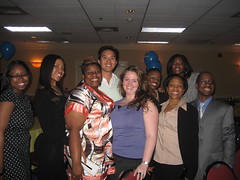
Me, Inc. Workshop at Summer Search Alumni Summit 2008

I had an absolutely fantastic time today with about 50 Summer Search alumni at their annual leadership summit at the Masonic Center in San Francisco. I facilitated a workshop entitled “Me, Inc.: Building Entrepreneurship into your Life,” which led to discussions on entrepreneurship and social entrepreneurship.

It was great to be in the presence of so many engaged, eager, and “hungry” leaders. I could tell that they were so ready and willing to absorb lessons so that they could take them back and affect change in their communities. It was so refreshing! Summer Search is definitely an organization to keep on your radar. This year they have a $12 million budget and seven sites across the nation serving almost 800 students. They want to aggressively grow with a capital campaign of $20 million, to serve 2,000 students in the next few years. Judging from the amazing individuals I met today, the program is working, and I look forward to seeing their growth in the next few years.

If you went to my workshop, and have questions, comments, or feedback for me, please do not hesitate to contact me! I know we ran out of time, and I could have spent hours more discussing it, so feel free to connect if you have any questions or ideas for me.

I also promised the Summer Searchers that I would post up my powerpoint presentation and worksheet on my site, so you can get them below. I only ask that if you found my tools useful, share the knowledge and tell someone about it. Maybe you can get together with people in your support networks to discover how each of you are living and being the CEO’s of Me, Inc.

To download the worksheet, right-click and “save as” the following link to get the PDF.

And lastly, if you are interested in learning more about the Level 5 Fellowship that I briefly alluded to or know someone who would be interested, please check out our website at level5.efozzie.com. Help us spread the word!

It was a pleasure and a privilege, Summer Searchers! Thanks!

12: The Elements of Great Managing

This summer I’m transitioning into the site director role at BUILD after three years of proudly serving as the incubator manager. Yes, I’ve known for a while, and we have been making announcements here and there in the BUILD community (during our after-school incubator sessions and a big announcement during the Business Plan Competition back in May), and I suppose now is as good of a time as any to make a general announcement about it. Indeed it is a promotion, and one that I am extremely excited about because not only will it be a huge opportunity of personal growth and professional development, but I get to do it in an organization I love, with a team a really care about, and with a mission that I value.

After speaking with our management consultant, Linda, I realize that one of my biggest hurdles will be shifting from the role of individual contributor to that of a manager / leader. Coincidentally, tomorrow is my final year-end performance review in my role as the incubator manager, and it is so neat to reflect back on my value-add as an individual contributor. I will never forget the trials and tribulations of creating and implementing my first Business Boot Camp (and only now am I truly seeing it objectively… yes, after two years, thanks to Karla‘s Results-Process-Relationships triangle), the collaboration with Randy and Adriana on “The Bridge” (one of my proudest accomplishments), and the painstaking task of creating an expansion manual for my programs (don’t get me wrong, I love creating processes, but somehow I really just love to keep them in my head, so this was a good project). Through it all, I’ve been stretched, stripped, and developed, but now it’s time to move on. Just like our students move from one phase of our programs to another, so too will I move, and entrust our excellent site program assistant, Amber, to innovate and improve the program in my place as the new incubator manager.

Oh, and I also wanted to add a book to my booklist, and it is somewhat related to my transition into my new management role: 12: The Elements of Great Managing.

by Rodd Wagner & James K. Harter, Ph.D.

The book shows the importance of employee engagement through several real-life business accounts (a la any other business-y book out there), and argues that you can manage people successfully if you implement these twelve essential elements:

  1. Knowing what’s expected
  2. Materials and equipment
  3. The opportunity to do what I do best
  4. Recognition and praise
  5. Someone at work cares about me as a person
  6. Someone at work encourages my development
  7. My opinion seems to count
  8. A connection with the mission of the company
  9. Coworkers committed to doing quality work
  10. A best friend at work
  11. Talking about progress
  12. Opportunities to learn and grow

Some of them are kind of, duh, obvious, like “materials and equipment” (who doesn’t need a computer, desk and chair these days?), but I thought some of the more interesting chapters were regarding the “best friend at work.”

Something about a deep sense of affiliation with the people in an employee’s team drives him to do positive things for the business he otherwise would not do. Early research that identified the 12 Elements revealed a very different social bond among employees in top performing teams. Sebsequent large-scale, multi-company analyses confirmed the 10th Element is a scientifically salient ingredient in obtaining a number of business-relevant outcomes, including profitability, safety, inventory, and — most notably — the emotional connection and loyalty of customers to the organization serving them. (page 140)

In short, friends watch each others’ backs. And having that culture is invaluable because not only is it good for individual and team morale, but your constituents (or customers) can feel and see it as well… And with the staff modeling it, they will then start to mimic it — e.g. If you are friends with your coworkers and show it at your youth-serving organization, your students will probably be more friendly with each other. Sounds easy enough, huh?

Maybe my first order of business as the site director with my team will be some forced bonding time. 😉

Read on for more quotes from the book:

Continue reading 12: The Elements of Great Managing

Mrs. Bill Gates on Philanthropy

The Gateses (Bill and Melinda, e.g. the third wealthiest family on the entire planet) are at a super geeky tech conference down in Carlsbad, CA, called All Things D. One of my favorite blogs, Gizmodo, (don’t judge me) has covered Melinda Gates’ interview by none other than the wise tech sage himself, Walt Mossberg.

In the interview, she talks about how her hubby is stepping down from the top seat at Microsoft to spend more time at the Gates Foundation. I don’t know about you, but I think it is an incredible gesture for this extremely intelligent leader of the tech industry to symbolically say, “I’ve done all I can in the tech industry, and now I want to focus my energy and skills on solving the world’s most pressing matters.” This is coming from the man who makes more money in 5 minutes, than I do for an entire year (yea… he makes an estimated $18,000 per minute). He can pretty much do anything he wants with his boatloads of money. He could sit at home all day and watch TV, he could run for president, or he could be build his own island continent in the middle of the Pacific Ocean with all of his piles and piles of cash.

But no. Instead he and his wife are choosing to fight malaria, HIV, the school drop-out crisis, and poverty to name a few of their key initiatives. If that’s not inspirational, I don’t know what is.

Mossberg: What’s the difference between your Foundation and others like it? More money?
Melinda Gates: We can take risks…

…Melinda says they could tap their entire budget by attempting to fix the problems in the education system alone. Their mission is more to help take on that risk that governments can’t in fixing problems.

One of the Gates Foundations’ key areas of focus is America’s ailing educational system, and the vast number of students who drop out of school every year. I’m looking forward to the risks they take in that arena.

Question from the crowd: How do you deal with violence in schools going from students to teachers?
Melinda says that comes from facelessness in big schools. She’s seen schools with three cop cars in front and two metal detectors. You can see the gangs going through schools and once the teachers recognize the kids, the kids act a lot better. Once the teachers know the kids’ names, these things fall into place. She’s seen schools that have fixed this in NY be able to lose their metal detectors, and graduation rates go up profoundly (up to 78%).

You can read the rest of the transcript below:

[All Things D Live: Melinda Gates, Bride of Bill via Gizmodo]

And you can read her “coming out” article here from Fortune: Melinda Gates goes public.

100%

That’s the percentage of my class of seniors at BUILD who have been accepted to college (and are going to college, God-willing).

100%!!!

And that statistic is not the only phenomenal fact. This remarkable group of high school seniors has gotten into some great schools like UCLA, UC Davis, UC Santa Cruz, St. Mary’s, Menlo College, SF State, San Jose State, Lehigh University, Augustana College, Bradley University, Northeastern University, UC Berkeley, and Santa Clara University. The last three colleges have even offered our students full-rides.

Full-rides!

These are students that four-years ago when we started to work with them were written off by the school system and tracked into remedial and non-college prep courses–because of the color of their skin or because their first language was not English or because they come from low income families, etc. These are the “better-than-their numbers” students who may have low-to-average GPA’s and SAT scores, but who have stories so remarkable that they will excel given any circumstances they face.

Needless to say, I am extremely honored and blessed to have the opportunity to work with my students. I’ve been working with this graduating class for three years now, and I will be the first one to admit that I will cry like a proud parent during their high school graduations–yes, I’m going to all four of them.

So to all of you who are graduating high school this semester and are going off to college, hang in there for the rest of the school year. Don’t get senioritis just yet. Keep giving it 100%.

On May 1st, you will have a very important choice to make. Be thoughtful. Be honest with yourself. And know whatever choice you make is yours and yours alone. Not your family’s. Not your teachers’ or counselors’. This is your future. You’ve made it this far, and I believe you know what will be right for you.

Know that you make at least one person (me, duh) proud, and there likely are many, many more.

Looking forward to a College Summit summer

I just got back from five fun-filled and exciting days in St. Louis, MO, for College Summit‘s annual Workshop Staff Training and a day of Rap Director Training.

Nine of the Talented TenThis year is heralding big changes (improvements, really) to one of my favorite national nonprofit organizations. They got rid of their clunky intra-net system, CSnet, and replaced it with a more streamlined and teen-friendly CSNav. They’ve drastically revamped the structure of workshops; instead of one-off workshops donated by willing colleges, they are purchasing space for 4-8 weeks at a time from a select few colleges in their 13 different regions. The new structure allows for economies of scale, reduced staff drain, and program efficiency.

Summer workshops this year will affect the lives of over 3,000 low income students nationwide from rural West Virginia to urban Oakland. And these trained Peer Leaders will go back to their schools to affect even more students who then will start to create a college-going culture in their communities. It’s no surprise that “79% of College Summit workshop participants enroll in college, significantly above the national average for low-income high school graduates. And 80% of those enrollees stay in college.”

And it’s no surprise that I am sitting here anxiously anticipating the summer to arrive so that I can go off to my serve at my workshops.

It’s easy for you to get involved too!

I highly encourage you to become a Writing Coach or College Counselor this summer. The commitment is 4 days (Thurs-Sun), and you must have your bachelor’s degree or higher. Check out College Summit’s website for more info. If you need more encouragement to apply, contact me.

Check out more pics from the weekend after the jump. Continue reading Looking forward to a College Summit summer

Diversity = Productivity

Karla and I have been racking our brains trying to figure out why the social sector is home to some of the least diversely populated organizations, and, subsequently, what can we do about it? So we have been doing our research to first find out how diversity improves the workforce (in business, government and the social sector), if it does at all. Surprisingly, we have not found a lot of empirical evidence that diversity actually improves organizations. In fact, a semi-recent study by famed researcher Robert Putnam (check out Financial Times article here) shows that diversity negatively affects civic life (not quite correlated with work life, but it’s still a blow to diversity advocates).

From the Financial Times:

His research shows that the more diverse a community is, the less likely its inhabitants are to trust anyone – from their next-door neighbour to the mayor.

However, another researcher, Scott E. Page, has found a positive correlation with diversity and productivity in the workplace and chronicled it in his recent book, The Difference: How the Power of Diversity Creates Better Groups, Firms, Schools, and Societies. Here’s a snippet of a conversation with the auther from an article in the New York Times:

An edited version of the interview and a subsequent phone conversation follow:

Q. In your book you posit that organizations made up of different types of people are more productive than homogenous ones. Why do you say that?

A. Because diverse groups of people bring to organizations more and different ways of seeing a problem and, thus, faster/better ways of solving it.

People from different backgrounds have varying ways of looking at problems, what I call “tools.� The sum of these tools is far more powerful in organizations with diversity than in ones where everyone has gone to the same schools, been trained in the same mold and thinks in almost identical ways.

This is exciting news for the diversity front! Now how can we translate that into the non-profit sector, which is mired with inefficiencies and challenges in the the talent acquisition, management and retention departments…?

“College Dropouts” are the new “High School Dropouts”

College enrollment rates are historically on the rise in the US. Stats from this fascinating book I’m currently reading, Microtrends by Mark J. Penn and Kinney Zalesne:

According to the National Center for Education Statistics, 69 percent of students who graudated from high school in 2005 were enrolled in college the following October. That was up from 59 percent in 1988, and up from 47 percent in 1973. Indeed, a record-high 54 percent of all Americans have been to some college. For the first time in American history, going to college is a majority expectation for families–most kids will start college–and over two-thirds of high school grads will.

Why is it that college graduation rates have stayed about the same, a paltry 66 percent for students in four-year institutions. And can you believe that that stat is dramatically lower for community colleges?

What does this mean for America today?

Well it means that although there are more Americans today entering college (which is fantastic especially because I have spent my life’s work for the past four years with BUILD and College Summit on this goal), there are also more Americans than ever dropping out, or taking a break from college, or being academically dismissed from college (for the sake of simplicity, I will just call these folks “college dropouts”).

More statistics:

  • 1 in 3 Americans in their mid-20s are now college dropouts (up from 1 in 5 in the late 1960’s).
  • Between 1995 and 2015, the number of undergraduate students in America is predicted to increase by 19 percent, to 16 million.
  • 80% of new students will be students color (hooray!), and many will be low-income and/or first-generation college-goers (double hooray).

However, if the dropout rate stays the same (at 66%), we could be facing somewhere around 1 million additional Americans every year prepared to do college-level work but not doing it.

Remember that college graduates earn over a million more dollars over their lifetimes than high school graduates. So think of the implications of having an additional million people every year who are college-ready, but doing high school graduate-level work and earning high school graduate-level wages. And my hunch is that a good majority of college dropouts will be the students of color and/or students who are low-income/first-generation because the reasons why students drop out of college are very basic: lack of money, lack of prior education, the urgent needs of their families, etc. (among other reasons).

Now I’m not standing here on top of my soapbox decreeing that every college dropout needs to go back to college to finish his degree because on some occasions, college may not be the right answer. I know first hand because some of the nearest and dearest to me are college dropouts of color, and they are doing fine (and are planning to go back to finish their degrees). I am saying, however, that the advantages of having a college education are extremely clear, and if we, as a nation and a community, are increasingly sending our students to college expecting them to succeed without the resources they need, then we are sending them ill-equipped and setting them up for failure. If we don’t act now, we can’t act surprised when our stellar cousin who aced all of his regular classes and got into a good state school, says that he’s not returning the following semester because he can’t afford the tuition, or he was dismissed for failing accounting.

Being Solutions-oriented

There are a lot of nonprofit organizations out there that prepare high school students to enter college; I mentioned BUILD and College Summit above because those are the ones that I work with now. The natural inclination that arises is to extend the resources that these similar students have been receiving into the undergraduate arena. BUILD or College Summit for undergrads? Not quite. Obviously we have to grow it up for the more adult audience, but that’s just one idea.

Students nowadays are facing enormous amounts of debt at a younger and younger age. Thirty years ago, you could graduate from UC Berkeley with barely $500 in student loans. Now, you are lucky if you graduate with $5,000 in debt, and the averages are more likely in the $15,500 for a public institution (!) and $19,400 for private universities (according to this USA Today article). Government really needs to bring back the love for students by upping grant money, and financial aid offices on campuses all over the country need to make it easier for students to access scholarships and other financial aid. And how about a mandatory course in financial management for all entering freshman… and an advanced financial management course for graduating seniors? Why is it just this year that I really learned how to keep a budget (almost four years out of college)?

And we as a community of people of color cannot stand by and watch our fellow Americans (or American residents) fail. I hate the whole lobsters in a bucket ideology that many communities of color subscribe to, especially communities of recent immigrants (e.g. Imagine several lobsters in a bucket. When one lobster tries to climb out of the bucket, generally the lobsters below it clamor to pull it down, and, thus, no lobsters escape the bucket.) We as a community of people of color need to educate ourselves and each other, and if our younger ones are to succeed, we need to give them the resources to succeed. In the very least we need to open up their possibilities so that they can see what success looks like. What does this mean in the practical sense?

  • Parents: look at your kids’ homework! Check it, and ask them the next day if they have turned it in. If you can’t help them with calculus, encourage them to go to tutoring. Teach them how to advocate for themselves at school so that they can get the resources for themselves. Man, it really is annoying when the resources are there and not being accessed by those who really need them. Teach your kids self-advocacy when they are young so when they get to college, they can actually use that skill!
  • Friends who don’t have kids: check-in with your relatives. Is your little cousin on the right college track? Is she taking the right classes? How about your cousin who’s in that state college? How’s he doing? Does he need some motivation? Why don’t you take him to work one day so he can see what it’s like to be a successful college graduate. And for crying out loud, volunteer! You are not an island, and your community needs your help.
  • Kids: If you’re not succeeding in a particular class or activity, tell someone. Get the help that you need. If that means less time playing Guitar Hero and one more hour of reading a book or working with a tutor, then so be it. You have all summer-long to play with your Xbox or Wii. Actually, don’t get me started with summertime; that’s a whole ‘nother tirade.

Now before you throw out celebrity examples of college dropouts who have been successful (like Bill Gates, Ellen Degeneres, etc.), my point is not that dropping out of college is a negative thing. It will happen, and statistically speaking, it’s not going to end. I am saying, however, that if our community of people wants to escape poverty and classism and is setting the expectation that our young ones are to succeed in college and in life, then we need to set them up so that they do succeed. And only we as a community of people of color can do that.

Who’s ready to help me start this new nonprofit then? Ha, just an idea. 😉

“We who believe in freedom have to rest.�

I’ve been listening to a great podcast series from the Conversation Network’s Social Innovation Channel, and listened to a keynote by a fascinating changemaker and human rights activist, Van Jones (he is the president and co-founder of the Ella Baker Center for Human Rights (EBC) based in Oakland, California).

He stresses the importance of allowing yourself to recharge, and to talk to people who aren’t involved in your work in order to get outside perspective. He emphasizes this by saying, “We who believe in freedom have to rest.�*

While it is so easy for us in this line of work to think that we cannot take a break or else world peace will never come, or the kids won’t get fed, or that they’ll chop down more trees, we have to remember that we can’t accomplish our missions if we first don’t find balance within ourselves.

How true it is. And right now we at BUILD are approaching our truest and only “slow” season–our week off between Christmas and New Years, and the first couple of weeks before the students come back to the program. Let’s all take this time to rest, reflect, and be with others who may not necessarily be in the social sector.

Continue reading “We who believe in freedom have to rest.�

Epiphanies are slow and gradual, not big bangs

Almost a year ago today, I thought of writing  a post with this title because I was driving to work with Karla and had an epiphany. It wasn’t a big huge crazy epiphany.

It was more like a puzzle all falling into place, and all of the pieces were gathered throughout time.

Anyway, the epiphany was that I wanted to teach at the university level. OK, so that unto itself is not a very concrete epiphany, but I like it the way it is. It’s flexible, and I am sure I can make it work.

Another great idea: A Summer of Service

Last month I wrote a post about how I have dedicated my life to serving children and youth, and after thinking about my past experiences and thinking about the Time article, I thought of another fun idea:

Kids have summers off, and most of the time if families don’t have money or resources to educate or keep their kids occupied during the summer, they are left to fend for themselves and basically end up watching TV.

Why not create a summer camp for kids from under-resourced areas where they learn about leadership by giving back to the community? It could be in a camp setting, in an urban setting, even in a suburban setting…  Clearly this idea is still very much in the idea stage… What do you think?