Trendspotting: Philanthropic Weddings

I’m going to four weddings in the next nine weeks. As Karla told me, we are coming to that age when many of our friends from high school and college are getting hitched.

I’m really looking forward to Mike and Alex’s wedding this upcoming Sunday because 1) Alex is one of my best friends and we go all the way back to the elementary school days, and 2) they’re employing what I think is a pretty neat philanthropic idea at their wedding.

You know how at the end of weddings, they give out those (usually) tacky wedding favors? Generally it’s a piece of plastic crap that has the couple’s names and the date of the wedding on it. Or perhaps it’s a food-related favor like a bag of cookies or packaged cupcakes. Alex’s idea was rather than paying $3-4 per person for a random wedding favor, she would instead donate the cost of the favors per person to a nonprofit organization that she and Mike valued. She  asked me to help her choose a nonprofit organization or charity that aligned with their values, and after some research, I sent her a list of 17 recommendations, and my opinions of each. The list included some of my favorite orgs like College Summit, Ashoka, and Green for All.

She recently told me that she and Mike chose BUILD (I swear I didn’t twist her arm or anything) as the recipient for the donation, and each guest at the wedding will receive, in lieu of a wedding favor, a little piece of paper describing the organization.

In two weeks, I’m attending Erwin and Coy’s wedding–Erwin is my chorus brother and their wedding will be my first gay one (Go California!)–and they are also employing philanthropy at their wedding. On the back of their invitation, they’ve written:

Because we already have more things than we need, in lieu of gifts we ask for donations to help continue the right of GLBT folks to marry. We encourage gifts to Equality California at www.eqca.org/wedding.

It’s hard not to be cynical at weddings, but given that both of these weddings have the underlying theme of giving back, I think they might turn out to be fun after all.

Mentoring as a form of activism

The 60’s and 70’s were all about the protests and activism. It’s hard not to think of hippies and  sit-ins at UC Berkeley’s campus when you think of that era.

Our generation has been faced with redefining our own form of activism, and I think we have found it largely by giving back to our communities. It’s a key theme on Michelle Obama’s platform as she makes her case to be the next First Lady of the US. Check out this excerpt from her speech at the Democratic National Convention:

I stand here today at the crosscurrents of that history — knowing that my piece of the American dream is a blessing hard won by those who came before me. All of them driven by the same conviction that drove my dad to get up an hour early each day to painstakingly dress himself for work. The same conviction that drives the men and women I’ve met all across this country:

…The young people across America serving our communities — teaching children, cleaning up neighborhoods, caring for the least among us each and every day.

…All of us driven by a simple belief that the world as it is just won’t do — that we have an obligation to fight for the world as it should be.

…And in my own life, in my own small way, I’ve tried to give back to this country that has given me so much. That’s why I left a job at a law firm for a career in public service, working to empower young people to volunteer in their communities. Because I believe that each of us — no matter what our age or background or walk of life — each of us has something to contribute to the life of this nation.

More and more people in this day and age are giving back to their communities much like the Obamas did and have been doing. I was pleasantly surprised to hear that Michelle Obama was a Public Ally, which is an Americorps program that trains young up and coming leaders to lead and serve in the public sector with a year of service at a nonprofit organization along with professional development. BUILD has been working with Public Allies for years, and I’ve had the immense privilege to be working alongside amazing allies like Elizabeth, Quynh, Alison and Naomi.

But I think a trend that continues to rise among young professionals is that they want to do well and do good, and mentoring programs continue to be a popular option for people to give back without giving up their corporate jobs. This is the very reason why BUILD’s mentor program is such a success. Not only do our students get exposure to talented professionals, but our volunteers, in turn, also get their horizons expanded by working with our enthusiastic students. I’m not going to lie and say it isn’t a challenge, but seeing mentors really connect with their students is worth that challenge. It changes everyone’s lives; students benefit, and the mentors personally develop as well.

If you don’t already mentor youth, I encourage you to get out there and start affecting the lives of youth. If you’re interested in mentoring our youth at BUILD, check out our website. The BUILD mentor program is a school-year-long commitment from October-May, and our mentors work with our Oakland and Peninsula students in a variety of capacities: helping them write a business plan, guiding them through the business start-up process, and supporting them as they apply to colleges. Apply to be a mentor today as spots fill up fast!

Like Michelle said, “Each of us has something to contribute to the life of this nation.” By raising up and educating our youth, we take one small step to advance our country.

Honoring our Tribal “Elders”

I’ve been thinking about culture incessantly as I have been getting situated in my new role as the site director at the BUILD Peninsula site.

The timing could not have been more appropriate. Over the last three years I’ve spent my summers designing and executing summer business boot camps for our sophomores and juniors with the goal of inculcating them to what I called the “Incubator culture.” Now as the site director, I have the distinct opportunity to extend that inculcation to my staff, so that our entire site–students, paid staff, volunteer mentors, and visitors–can tangibly feel our culture when they walk through our front door.

On a very basic level, the culture of our site mirrors that of a tribe. Yes, I’m talking about “tribe” as in a group of people who share a common ancestry, or a clan forming a close-knit community under a defined leader, chief, or ruling council. When you hear “tribe,” visions of Native Americans traveling together in a banded group under a chief leader probably come to mind. Well, if you think about it, this is where humanity stems from. Humans (homo sapiens) have been around for 250,000 years, and our species only really began to flourish when early humans learned to band together in tribes for survival. Embedded deep in our ancestral roots, we all come from tribes, and, in contrast, the notion of the “modern civilization” has only been around for the last couple of millenia.

As humans entered the era of modernity after the industrial revolution, and more and more people populated large urban areas, tribal elements became an antiquated idea of the past. But did they disappear? I think they were just translated into modern versions of what we call organizational culture. The four basic elements of this culture are simply rules, rewards, routines, and rituals. These four R’s can be found scattered all over the place in our homes, at our schools, our corporations, places of worship, and even our media.

At today’s E2 Boot Camp, we practiced a ritual, which we had never done before, and it all started with a hunch. Tribes honor their wise elders and ancestors–think back to Native Americans and their beliefs in ancestral spirits and the leadership of their chieftans. In modern translation, corporations do the same exact thing. Instead of invoking ancestral spirits, founders and corporate leaders (presidents, CEO’s) act as the organization’s wise elders and ancestors. Have you wondered why you can usually find a picture of their revered founder smack dab in the middle of a corporate lobby?

In translation to our youth-serving organization, there’s a lot of value for our students to have that same tribal sense of leadership and respect for their elders. At BUILD today, our “elder” is our young Founder and CEO Suzanne. She stopped by our Boot Camp to formally welcome our students into our Incubator program and to answer their questions about our organization’s future. What Suzanne didn’t know was that the students had planned to honor her for all of her hard work, and you can watch a snippet of our “ritual” in the youtube video below or at this link.

In fact the entire four-day Business Boot Camp for our sophomores is one big ritual to prepare them for the rigor and routines during the school year. And hopefully the addition of this new ritual of honoring our leaders can become a staple in our culture.

What rituals do your organizations perform, practice, or celebrate?


And as for the rest of the “R’s,” I’ll keep the conversation going on as culture seems to be the hot topic right now. Stay tuned.

Gratitude from College Summit USC Workshop

I’m just now getting a chance to do a recap on my first College Summit workshop, which happened at the end of June. We already know that the CS workshops are phenomenal, and that I highly recommend volunteering at them.

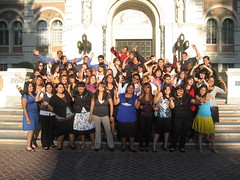
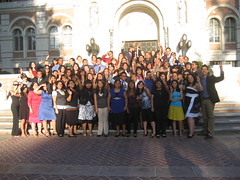
I had a great time co-rap directing with my best friend Karla at our alma mater. It was a perfect recipe for a great workshop,  and I met some great alumni leaders and volunteers. But to top all that off, we had a fantastic group of 50 students from Arleta High School with whom I literally fell in love. It’s hard to describe it when that magic moment happens at a workshop, but it happened with us at USC. Volunteers and workshop staff do workshops for many reasons, but I cannot describe the real draw, which has something to do with the love that encompasses the entire workshop. This is what makes volunteers keep coming back year after year, and this is what makes the workshops succeed.

Below are a couple pics from the USC workshop, and a tribute that one of our students, Jay Jay, made for us via youtube.

50 Peer Leaders at College Summit USCCollege Summit USC Fighting On


This is a video capture that Jay Jay uploaded of Karla and I at the banquet:


Hopefully that gave you a small taste of why I love College Summit workshops.

Great feedback for my workshop

I got a sweet note from Cynthia, who is a Summer Search alum and staff member, about my workshop. Check it out below!

Rey,

I did not have a chance to connect with you after your workshop, but I really wanted to say THANK YOU!

You were amazing. I got SOOOO much out of the workshop, I could not go to sleep all weekend. I called my friends and repeated the workshop word for word and I told them I would pass along your website information. I am excited about setting goals for myself (with dates and times these goals should get accomplished), and more importantly, I am excited to think more about my values. I also look forward to creating my elevator pitch and just living a more full life, doing the things that I am passionate about.

I could feel your passion throughout your presentation and I wish you were offering what you do at BUILD to young professionals like me.  

Again, thank you.

Also, Summer Search received a grant from the GAP Foundation and we are going to have Career Discovery Days next week. Our juniors and seniors will job-shadow at different sites in Silicon Valley. I am wondering if you would be interested in giving the presentation you gave at the Summit to our current students who are interested in business and social entrepreneurship. If you are available and interested, your workshop would take place on Thursday, August 8th from 10am -1:30pm.  I know this is really short notice, and I look forward to talking with you about this possible opportunity.

Take care,

Cynthia

Dont forget, if you want the documents from my workshop, check out my previous post here. Or if you want to follow up on anything you learned at the workshop, email me.

I would also love to spread this knowledge out. I realize that I really enjoyed facilitating this workshop and empowering young nonprofit professionals of color. If you know of any groups of young professionals or college-aged people that would benefit from this training, contact me.

Me, Inc. Workshop at Summer Search Alumni Summit 2008

I had an absolutely fantastic time today with about 50 Summer Search alumni at their annual leadership summit at the Masonic Center in San Francisco. I facilitated a workshop entitled “Me, Inc.: Building Entrepreneurship into your Life,” which led to discussions on entrepreneurship and social entrepreneurship.

It was great to be in the presence of so many engaged, eager, and “hungry” leaders. I could tell that they were so ready and willing to absorb lessons so that they could take them back and affect change in their communities. It was so refreshing! Summer Search is definitely an organization to keep on your radar. This year they have a $12 million budget and seven sites across the nation serving almost 800 students. They want to aggressively grow with a capital campaign of $20 million, to serve 2,000 students in the next few years. Judging from the amazing individuals I met today, the program is working, and I look forward to seeing their growth in the next few years.

If you went to my workshop, and have questions, comments, or feedback for me, please do not hesitate to contact me! I know we ran out of time, and I could have spent hours more discussing it, so feel free to connect if you have any questions or ideas for me.

I also promised the Summer Searchers that I would post up my powerpoint presentation and worksheet on my site, so you can get them below. I only ask that if you found my tools useful, share the knowledge and tell someone about it. Maybe you can get together with people in your support networks to discover how each of you are living and being the CEO’s of Me, Inc.

To download the worksheet, right-click and “save as” the following link to get the PDF.

And lastly, if you are interested in learning more about the Level 5 Fellowship that I briefly alluded to or know someone who would be interested, please check out our website at level5.efozzie.com. Help us spread the word!

It was a pleasure and a privilege, Summer Searchers! Thanks!

The Importance of Collaboration to Endure the Economic Downturn

I attended the first in a set of free quarterly workshops/discussions for non-profit organizations called “Power of Partnership,” co-presented by Craigslist Foundation, The Foundation Center, and Northern California Grantmakers. Tonight they had three panelists discussing the importance of collaboration between non-profits in the face of the state and nation’s budget crises.

A few highlights from the panelists:

Jacob Harold, Program Officer at the William and Flora Hewlett Foundation said some very insightful things about the current state of the nation and world in regards to philanthropy: Foundations, from the non-profit’s point of view, look like big entities that wield a lot of power. Jacob argued that they are bit players in the change game. He said that the Hewlett Foundation invests about $20 million per year to improve the California community college system, but the aggregate budget for the whole community college system is over $6 billion per year!

He also said several times that “the world is in flux,” and the basis of power is moving from organizations to networks that have the ability to mobilize quickly, accomplish their goal, and then disperse quickly. And despite the fact that the amount of money/funding is going down, social need is going up. How are these needs being met? With more efficient networks of people, and not clunky, bureaucratic organizations.

Sherry Simmons from the Northern California Community Loan Fund decrees that in order for organizations to successfully collaborate they need: 1) to have a clear goal, 2) to clarify the shared measures of success, and 3) to bring the right people together.

She also shared the story of how a coalition led by the Silicon Valley Council of Nonprofits worked together to fight proposed budget cuts in Santa Clara County–and they won by banding together, instead of getting picked off one-by-one.

Steve Fields from S.F. Human Services Network facetiously recounted former SF Mayor Willie Brown’s take on collaboration: “The definition of collaboration is what you think the other guy should be doing to further your agenda.” Obviously he disagrees, but it painted a picture of how government views collaboration with the non-profit sector (e.g. it doesn’t really exists).

Biggest Take-aways

  1. Collaboration is difficult because non-profits get really stuck in their own proprietary silos
  2. Multi-organization collaboration is a necessity, not just for funding, sharing resources, or sharing best practices, but more importantly for survival. As we face an economy and world in flux, more often than not, the non-profit sector is the first to lose funding. We must make it a priority to band together, realize that we are not competing with each other, and understanding that we are all providing unique services for the betterment of the entire community.

Who said anything worthwhile was easy? Are you currently collaborating in meaningful ways with other organizations?

Back from a Cathartic Journey

I knew my month-long trip was going to be awesome, but I didn’t really expect it to be as life-changing as it was. I just got home today, and I’ve got a lot more processing to do on the entire trip from LA to North Carolina to New York and then Miami, but let’s just say it was a cathartic and freeing adventure.

I’ll write more about it later, once I get some proper sleep in my own bed (instead of 4 hours a night on a mushy hotel pillow).

For now I’ll leave you with this short review from Steve on our GALA performance of USS Metaphor in Miami: GALA and the Fabulous USS Metaphor.

All I can say is the house was rockin’! It’s an sharply satirical look at the military’s insidiously ridiculous “Don’t Ask, Don’t Tell” policy and it’s available on DVD. I really recommend it for anyone who enjoys a great show, enjoys Gilbert & Sullivan and who understands how stupid the whole policy is.

Picturing Excess

It’s 3 am, and for some reason I cannot fall asleep. Well I suppose it has something to do with the month-long, action-packed, 8,000-mile, cross-country trip that I’m starting tomorrow… first to Sausalito for a BUILD work retreat.

As a parting gift, here’s a fascinating TED talk by artist Chris Jordan, who blends visual art with unimaginable statistics to uncover the excesses and truth in American culture.

1 million plastic cups are used on airline flights every 6 hours and virtually none of them are reused. What? Insane. I’ll definitely be using my travel mug on my flights.

Catch you all in July!

12: The Elements of Great Managing

This summer I’m transitioning into the site director role at BUILD after three years of proudly serving as the incubator manager. Yes, I’ve known for a while, and we have been making announcements here and there in the BUILD community (during our after-school incubator sessions and a big announcement during the Business Plan Competition back in May), and I suppose now is as good of a time as any to make a general announcement about it. Indeed it is a promotion, and one that I am extremely excited about because not only will it be a huge opportunity of personal growth and professional development, but I get to do it in an organization I love, with a team a really care about, and with a mission that I value.

After speaking with our management consultant, Linda, I realize that one of my biggest hurdles will be shifting from the role of individual contributor to that of a manager / leader. Coincidentally, tomorrow is my final year-end performance review in my role as the incubator manager, and it is so neat to reflect back on my value-add as an individual contributor. I will never forget the trials and tribulations of creating and implementing my first Business Boot Camp (and only now am I truly seeing it objectively… yes, after two years, thanks to Karla‘s Results-Process-Relationships triangle), the collaboration with Randy and Adriana on “The Bridge” (one of my proudest accomplishments), and the painstaking task of creating an expansion manual for my programs (don’t get me wrong, I love creating processes, but somehow I really just love to keep them in my head, so this was a good project). Through it all, I’ve been stretched, stripped, and developed, but now it’s time to move on. Just like our students move from one phase of our programs to another, so too will I move, and entrust our excellent site program assistant, Amber, to innovate and improve the program in my place as the new incubator manager.

Oh, and I also wanted to add a book to my booklist, and it is somewhat related to my transition into my new management role: 12: The Elements of Great Managing.

by Rodd Wagner & James K. Harter, Ph.D.

The book shows the importance of employee engagement through several real-life business accounts (a la any other business-y book out there), and argues that you can manage people successfully if you implement these twelve essential elements:

  1. Knowing what’s expected
  2. Materials and equipment
  3. The opportunity to do what I do best
  4. Recognition and praise
  5. Someone at work cares about me as a person
  6. Someone at work encourages my development
  7. My opinion seems to count
  8. A connection with the mission of the company
  9. Coworkers committed to doing quality work
  10. A best friend at work
  11. Talking about progress
  12. Opportunities to learn and grow

Some of them are kind of, duh, obvious, like “materials and equipment” (who doesn’t need a computer, desk and chair these days?), but I thought some of the more interesting chapters were regarding the “best friend at work.”

Something about a deep sense of affiliation with the people in an employee’s team drives him to do positive things for the business he otherwise would not do. Early research that identified the 12 Elements revealed a very different social bond among employees in top performing teams. Sebsequent large-scale, multi-company analyses confirmed the 10th Element is a scientifically salient ingredient in obtaining a number of business-relevant outcomes, including profitability, safety, inventory, and — most notably — the emotional connection and loyalty of customers to the organization serving them. (page 140)

In short, friends watch each others’ backs. And having that culture is invaluable because not only is it good for individual and team morale, but your constituents (or customers) can feel and see it as well… And with the staff modeling it, they will then start to mimic it — e.g. If you are friends with your coworkers and show it at your youth-serving organization, your students will probably be more friendly with each other. Sounds easy enough, huh?

Maybe my first order of business as the site director with my team will be some forced bonding time. 😉

Read on for more quotes from the book:

Continue reading 12: The Elements of Great Managing