Personal Philanthropy Plans

Here’s something to think about during this sunny Memorial Day weekend:
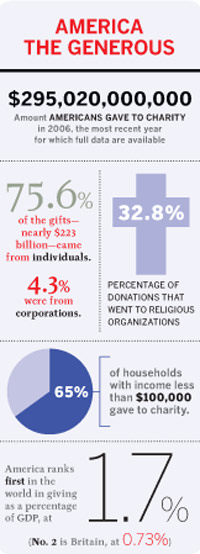
America ranks first in the world in giving as a percentage of GDP at 1.7%. (Data and the stats on the right is from last month’s issue of Fast Company.)

Can you imagine if every family in the US planned to give at least 1.7% of their gross income to charity? I know that statistically speaking, Americans are the most “generous,” but how many families, and even individuals, out there really have a philanthropy plan built into their budgets?

When I stopped to think about it, I realized that I don’t really have a philanthropy plan. I can’t even count how many times I have been asked to give money to a friend who was riding in the AIDS Lifecycle or running a marathon for Komen for the Cure. But I hesitate to give because 1) I work in non-profit, and let’s be real, the pay isn’t the highest in the world, and 2) it’s hard to keep track of my giving throughout the year. There seems to ALWAYS be a cause out there that needs money, from HIV/AIDS in the gay community, to natural disasters in Asia, to starving children, to starving gay children suffering from AIDS in Asia. I can see how it can get overwhelming, and even tiring, to the layperson.

But imagine if everyone had a philanthropy plan where she:

  1. budgeted to give away at least 1.7% of her gross income every year, and
  2. had specifically chosen nonprofit organization(s) that aligned with her values to give that money to.

For the average full-time working person who makes the median income of $43,317 (from wikipedia), that would equate to being able to give away $736.38 per year. How many of us gave $736.38 or more last year? I think I gave someone $100 for a marathon last year, but that’s about it. And it wasn’t like I had thought beforehand for whether or not giving money to this person had anything to do with my values. I pretty much just gave her that donation because she was my friend. But if you really stopped to think about where you want your money to go, and where you want your money to make the most impact, wouldn’t that be more empowering?

As an individual or a family, look at how powerful it is to be able to say, “One of my/our values is ABC, and therefore I/we gave 1.7% of my income to XYZ organization. ” (Fill in “ABC” with your values, and”XYZ” with your favorite nonprofit org that aligns with those values.)

Now that’s really putting your money where your mouth is.

Imagine if we built this culture of giving into our families… No matter how big or small your family income is, what an important lesson it would be for our children! Maybe for your child’s/sibling’s/parents’ next birthday present, you can give him/her the power to give money to their favorite cause.

Anyway, just some food for thought during this nice long weekend. Anyone out there have a personal/family philanthropy plan that you swear by?
Help me bring Learn-a-Palooza to SF

Karla was telling me about this fantastic community-organized event they hold annually in DC called “Learn-a-Palooza.” Check out the description from their FAQ:

Learn-a-Palooza is a day-long fair being held May 10, 2008 where DC’s Mid-city (Adams Morgan, U St, Columbia Heights, Dupont) residents, artists, and business owners will offer classes on hundreds of different topics. Classes will range from “3 Basic Yoga Poses”, to “How to Change a Bike Tire”, to “10 Words in Farsi”, to “Columbia Heights History”, to “Intro to Red Wine”, to “Learn to Sing”, to “Be a YouTube Star”. Anyone who has something to share (and basically we all do) can offer a class.

The event will be free and open to the public.

How cool is that??? I feel like this is something that should have already been happening in San Francisco. Maybe we do? Has anyone heard of anything like this in SF?

If not, I don’t think it would be too hard to put together. And imagine the benefits! Community engagement, learning for the masses, people getting to step out of their comfort zones, businesses/organizations getting exposure. The benefits are limitless.

Who wants to help me organize this for 2009? If anything, it will be an interesting experiment in community engagement.

When Stories Don’t Align

This is a post about how a simple Sunday afternoon activity reminded me that stories are extremely important to consider in both business and nonprofit organizations.

Billy and I were shopping in downtown San Francisco because I wanted to buy a new shirt for BUILD’s Business Plan Competition. Normally I don’t shop at J. Crew, but I had a gift card there, so that’s where we found ourselves. Here we were in the J. Crew men’s section, and I felt so out of place. So completely out of place. It seemed like all of the clothes were nonchalantly pointing out that I didn’t belong there. I don’t know if any of you frequent J. Crew, but their latest fashions included various Nantucket/Martha’s Vineyard-inspired leisure-wear including light blue seersucker short shorts, a variety of rustic-looking polos in shades of aquamarine, and bold striped ties that sell for about $50.

Red sailboat beltMy gift card had $20 on it, and thus I was trying to find something in that price range (which at J. Crew is hard to do), and I found a belt on sale for $19.99. The belt was cute and red with little sailboats, and Billy said, “Um no. You’re not going sailing anytime soon, and you’re a not a kid.”

And I said, “W0w, you’re right. I’m not going sailing, I don’t have a yacht nor do I have access to one, and neither do my friends. And there is no sailing or yachting anytime in my near and even distant future.”

And that’s when I realized that the J. Crew story and my story were not aligned. Their story, while there’s nothing inherently wrong with it, just was not resonating with my personal value system. Or as Karla eloquently said, “Cause you’re not white and working at Deloitte?”

Pretty much.

Organizations, whether for-profit or non-profit, tell stories. I personally think that it’s a little bit easier for for-profit businesses to tell stories because 1) they only have to appease to customers and 2) there is only one determining factor to which business is measured: profit. When nonprofit organizations tell stories, however, they not only have to speak to their customers (clients), but they also have to use that story to engage funders, volunteers, board members, employees, and other stakeholders.

Your nonprofit organization has to create that story and pretty much build it into every detail. And that story has to align with your core audience of clients, funders, volunteers, board members, and employees. Luckily, nonprofits inherently have interesting and remarkable stories, but they are not all created equal.

People who can identify with BUILD’s story may not with a Teach for America’s or College Summit’s. In fact, I think it would be an interesting exercise to really figure out the type of person that BUILD’s story really resonates with. I wonder whether or not that story is consistent from the clients (our students) to the volunteer mentors to our funders.

I have a hunch that once the BUILD story and our messaging of that story is tightened up, we’d be more scale-ready.

Oh and by the way, I did not end up getting the belt, and instead I bought underwear. I figured that underwear is always necessary, and I wouldn’t have to promote the J. Crew story since it’d be hiding beneath my clothes.

Does your organization’s story align with the core audience’s stories?

College Summit on PBS

I know I just blogged about how people are watching TV less, but I just couldn’t resist this one (besides it’s on PBS, and you can access it on the interwebs).

PBS’s NOW show (a national news show) has tracked a handful of College Summit students in Denver, Colorado over the past year from a CS workshop to the present. The spot really highlights some of the challenges students go through on a daily basis and how the students have overcome those challenges to move onto higher education, with College Summit’s help, of course. And it showcases JB Schram (“National Education Expert,” according to the NOW anchor, hehe), College Summit’s founder and CEO, talking about the nation’s pressing need for a college-going culture. It was great to hear him talk about CS making an impact on a national scale.

If I haven’t sold the program enough, check out the show by clicking on this link (once you are at the PBS website, the video is on the right-hand column). I have been eagerly awaiting this spot to come out on TV since last summer when Karla told me that they were going to film HER workshop in Denver… and you actually get to see Karla in her element for a minute in the show!

Let me know what you think via comments.

100%

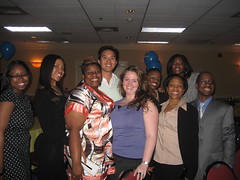
That’s the percentage of my class of seniors at BUILD who have been accepted to college (and are going to college, God-willing).
100%!!!

And that statistic is not the only phenomenal fact. This remarkable group of high school seniors has gotten into some great schools like UCLA, UC Davis, UC Santa Cruz, St. Mary’s, Menlo College, SF State, San Jose State, Lehigh University, Augustana College, Bradley University, Northeastern University, UC Berkeley, and Santa Clara University. The last three colleges have even offered our students full-rides.

Full-rides!

These are students that four-years ago when we started to work with them were written off by the school system and tracked into remedial and non-college prep courses–because of the color of their skin or because their first language was not English or because they come from low income families, etc. These are the “better-than-their numbers” students who may have low-to-average GPA’s and SAT scores, but who have stories so remarkable that they will excel given any circumstances they face.

Needless to say, I am extremely honored and blessed to have the opportunity to work with my students. I’ve been working with this graduating class for three years now, and I will be the first one to admit that I will cry like a proud parent during their high school graduations–yes, I’m going to all four of them.

So to all of you who are graduating high school this semester and are going off to college, hang in there for the rest of the school year. Don’t get senioritis just yet. Keep giving it 100%.

On May 1st, you will have a very important choice to make. Be thoughtful. Be honest with yourself. And know whatever choice you make is yours and yours alone. Not your family’s. Not your teachers’ or counselors’. This is your future. You’ve made it this far, and I believe you know what will be right for you.

Know that you make at least one person (me, duh) proud, and there likely are many, many more.

Looking forward to a College Summit summer

I just got back from five fun-filled and exciting days in St. Louis, MO, for College Summit‘s annual Workshop Staff Training and a day of Rap Director Training.

Nine of the Talented TenThis year is heralding big changes (improvements, really) to one of my favorite national nonprofit organizations. They got rid of their clunky intra-net system, CSnet, and replaced it with a more streamlined and teen-friendly CSNav. They’ve drastically revamped the structure of workshops; instead of one-off workshops donated by willing colleges, they are purchasing space for 4-8 weeks at a time from a select few colleges in their 13 different regions. The new structure allows for economies of scale, reduced staff drain, and program efficiency.

Summer workshops this year will affect the lives of over 3,000 low income students nationwide from rural West Virginia to urban Oakland. And these trained Peer Leaders will go back to their schools to affect even more students who then will start to create a college-going culture in their communities. It’s no surprise that “79% of College Summit workshop participants enroll in college, significantly above the national average for low-income high school graduates. And 80% of those enrollees stay in college.”

And it’s no surprise that I am sitting here anxiously anticipating the summer to arrive so that I can go off to my serve at my workshops.

It’s easy for you to get involved too!

I highly encourage you to become a Writing Coach or College Counselor this summer. The commitment is 4 days (Thurs-Sun), and you must have your bachelor’s degree or higher. Check out College Summit’s website for more info. If you need more encouragement to apply, contact me.

Check out more pics from the weekend after the jump. Continue reading Looking forward to a College Summit summer

Check out one of my students in the Palo Alto Daily

Gilberto Soria, senior, was recently profiled in the Palo Alto Daily. Click here for the link to the article about Gilberto. It’ll give you a small taste of the students I work with at BUILD… And I know if Gilberto read this post, his ego would be inflated even more, but nonetheless, I”m pretty proud of him.

Fourteen acceptance letters later, Soria’s mind is running wild: the University of California at Los Angeles, or Berkeley – or maybe a chilly stretch in New England at Northeastern University, which has offered Soria a full ride scholarship.

Check out the rest of the article after the jump… Continue reading Check out one of my students in the Palo Alto Daily

Three Cups of Tea

Three Cups of TeaThree Cups of Tea: One Man’s Mission to Promote Peace . . . One School at a Time

By Greg Mortenson and David Oliver Relin

I loved the themes of facing insurmountable odds and overcoming even larger obstacles in this book. Greg Mortenson turned the huge failure of not climbing to the top of K2 into a life of even higher summits. This book was a fascinating and inspirational read, especially if you are interested untraditional nonprofit work. And by “untraditional,” I mean nonprofit work that we don’t always hear about or read in the newspaper, like Ashoka, TFA, or College Summit.

One of my favorite quotes from the book:

“That Day Haji Ali taught me the most important lesson I’ve ever learned in my life,” Mortenson says. “We Americans think you have to accomplish everything quickly. We’re the country of thirty-minute power lunches and two-minute football drills. Our leaders thought their ‘shock and awe’ campaign could end the war in Iraq before it even started. Haji Ali taught me to share three cups of tea, to slow down and make building relationships as important as building projects. He taught me that I had more to learn from the people I work with than I could ever hope to teach them.”

Diversity = Productivity

Karla and I have been racking our brains trying to figure out why the social sector is home to some of the least diversely populated organizations, and, subsequently, what can we do about it? So we have been doing our research to first find out how diversity improves the workforce (in business, government and the social sector), if it does at all. Surprisingly, we have not found a lot of empirical evidence that diversity actually improves organizations. In fact, a semi-recent study by famed researcher Robert Putnam (check out Financial Times article here) shows that diversity negatively affects civic life (not quite correlated with work life, but it’s still a blow to diversity advocates).

From the Financial Times:

His research shows that the more diverse a community is, the less likely its inhabitants are to trust anyone – from their next-door neighbour to the mayor.

However, another researcher, Scott E. Page, has found a positive correlation with diversity and productivity in the workplace and chronicled it in his recent book, The Difference: How the Power of Diversity Creates Better Groups, Firms, Schools, and Societies. Here’s a snippet of a conversation with the auther from an article in the New York Times:

An edited version of the interview and a subsequent phone conversation follow:

Q. In your book you posit that organizations made up of different types of people are more productive than homogenous ones. Why do you say that?

A. Because diverse groups of people bring to organizations more and different ways of seeing a problem and, thus, faster/better ways of solving it.

People from different backgrounds have varying ways of looking at problems, what I call “tools.� The sum of these tools is far more powerful in organizations with diversity than in ones where everyone has gone to the same schools, been trained in the same mold and thinks in almost identical ways.

This is exciting news for the diversity front! Now how can we translate that into the non-profit sector, which is mired with inefficiencies and challenges in the the talent acquisition, management and retention departments…?