Letter to my Graduating Seniors

So proud of my boys!
Alfonso, Rey, Sean at Sequoia High Schools' Graduation

I’m heading to BUILD’s Second Annual Graduation and First-ever Alumni Homecoming at Notre Dame de Namur University in Belmont today. I’m super excited because I started working at BUILD when these guys were freshmen. I feel like in many ways I’m graduating right alongside them. Here’s an open letter that I wrote to them:

Dear Graduates,

From the very first day of the BUILD class during your freshman year you all shined and showed amazing potential. Over the last four years, we ushered and guided you through the BUILD program and challenged you in ways that none of your peers were being challenged. Through the challenges of creating a business, building a team, and learning what it takes to really run a business, you exceeded expectations over and over again.

Since then we have had lots of great times—like the amazing college tours to Los Angeles and San Diego, our Business Plan Competition with the Oakland students, and the countless nights in the Incubator with the BUILD family—and also lots of challenging times—like the deaths of loved ones, violence in our community, and other personal struggles—but through it all, we all stuck together and supported each other. When the challenges confronted you, you didn’t give up. You made positive choices, persevered, and defied stereotypes.

When you get to college, know that even though we will no longer be there with you physically, you already have everything you need to be successful. You have always had it. It’s what made you a success at BUILD in the first place. Continue to speak up and advocate for yourselves, and remember to keep that ambitious fire lit inside of you.

Don’t ever forget that you helped to make the BUILD Peninsula site the beautiful, warm, and special place that it is, and you will always have a place here. On behalf of the entire BUILD staff, we hope you come back to visit often or in the very least send us messages on Myspace or Facebook (or the old fashioned email) with tales from college. We are blessed and fortunate that you all chose BUILD as your vehicle to access higher education, which will ultimately give you the tools necessary to excel in education, lead in your communities, and succeed professionally.

Congratulations, graduates, and best wishes!

Waiting for Impact

In youth development work, it’s rare to ever see the fruits of your labor — the actual impact that your work makes. When I was working in my first social change organization, Troy Camp, almost exactly ten years ago, I inherently knew that the mentorship that I was providing was a good thing to do, and it was fun to do. By the end of the school year, the outcome was that we went to camp and had a year full of activities and events with impressionable youngsters from inner city Los Angeles.

The impact, however, was not as clear. After the year was up, a majority of the students who ran Troy Camp lost touch with the youth that they were mentoring, and we could hardly keep up with all of the Troy Camp alumni. There were / are no systems in place, like MOST nonprofits out there right now, to keep track of the clients and the long-term impact that the organization had on the youth. But then again, Troy Camp didn’t really make any promises either. Rather, we made vague promises of a “Commitment to Friendship” and a summer of fun in the wilderness. But back then we were not as savvy as organizations are today–Today’s organizations promise tangible and relevant outcomes and impact — i.e. “increasing the college enrollment rate of low income students”.

And so our organizations embark on lengthy evaluations, both internal and external, calling upon expensive expert evaluators to interview stakeholders, board members, clients, alumni, and staff members, to answer a pretty simple question: Are we making an impact?

This month’s BUILD college tour to San Diego cemented that answer for me, again (it’s good to get a reminder every now and then). It was the eighth college tour I had chaperoned with BUILD, and, hands down, it was the best and most fun one. What was the difference? Maybe I was more alive and more awake to see the subtle changes that students were going through. Maybe it was easier for me to notice their “turning points” or their “moments” on the campus that would forever make an impression on them… so that they are motivated to better in school. Maybe it was because the staff was happier, students were happier, too? Maybe it was the other way around? Either way, the outcome shines: 45 impressionable young minds were exposed to new and inspiring worlds. Now the questions remain: Will the college tour make an impact? Will the college tour motivate them to get better grades so that they can be competitive for these schools? My hunch is yes, and here’s why:

A week ago, Karla forwarded me an email that she got from a current member of Troy Camp, and the email was from a former Troy Camp kid who went to camp in 2002.

To whom it may concern,

As a 3rd grader at 32nd St. Performing Arts Magnet, I was chosen by my teacher to attend Troy Camp along with several of my other classmates. At Troy Camp, I met numerous USC undergraduates, who I will always remember by their nicknames (Snuggles, Fuzzy [sic], etc.). I created a bond with my fellow classmates, new friends, and the Trojan Family. My week at Troy Camp is definitely one of my fondest memories, thus far, and I even tried to attend it once again in 5th grade. Though I didn’t participate in your “follow-up” programs like SMASH, I’m extremely proud of the USC undergraduates for helping out the neighboring schools in such ways. I have been admitted to USC this fall, and wanted to personally let Troy Camp know that the wonderful experience I had in the woods initiated my desire to not only attend SC, but to pursue an education at an academically enriching institution. I am currently undecided about my college plans, but if I do attend USC (I hope I do!), I can’t wait to become a Troy Camp counselor. I hope this e-mail demonstrates that Troy Camp is a great program, and has inspired and will keep inspiring youth to pursue higher education. I congratulate everyone who helps organize and run Troy Camp. Fight on!

Sincerely yours,
Blanche

Although she spelled my camp name wrong, it was awesome to know that we made an impression on this young woman, and that Troy Camp had made an impact on her life even eight years later. I secretly hope she chooses USC, and Blanche, if you’re reading this, contact me! I’d love to help you out with your college decision-making process.

Now you might be thinking that eight years is just far too long to wait for an impact. But imagine all of the seeds that were planted years ago that are about to bloom. Imagine all of the seeds of knowledge and power that are being planted right now in young social change makers in organizations like BUILD and Troy Camp. In our world of metrics, databases, and spreadsheets, we expect impact immediately. And while quantitative analysis has its place in nonprofit organizations, the letter from Blanche serves as a reminder to me that sometimes impact has it’s own timeline, and we do not always have control over how and when that impact will happen. All of the students that we serve right now might not be able to realize their potential, but in the meantime, we can plant the seeds of hope and create immediate outcomes that will one day blossom into the impact that we had hoped for.

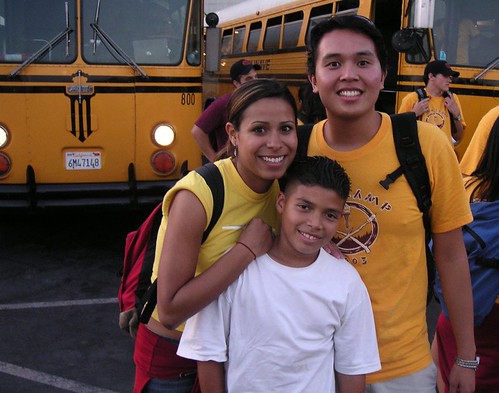
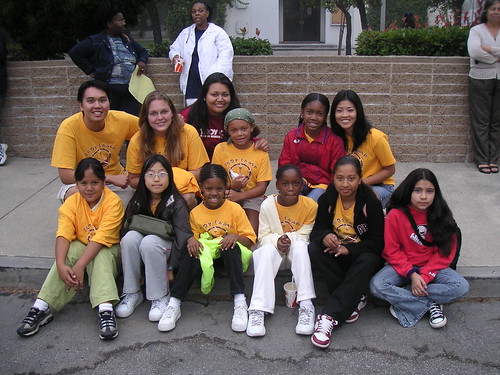
FYI, the pics I’ve added to this post are not of Blanche, but are of the last Troy Camp event I attended — at Disneyland in September 2003.

Bill Gates Talks Successes & Failures in First Annual Letter

I feel like a Bill Gates fanboy. He’s one of the few public figures that I seem to continually bring up in my posts because I think so highly of his move from Microsoft to the Bill & Melinda Gates Foundation six months ago. When he first made the announcement that he had planned to do that, it was an acknowledgment to the entire world that we are facing extremely grave social problems, and that it was going to take commitment from talented people to solve those problems. And it was like a high five for the nonprofit sector. Thanks Billy.

Recently, Bill released a public letter about the foundation’s  efforts to improve education and global health, as well as the impact of the economic downturn on those efforts.

What I liked about the letter was Bill’s candid review of the foundation’s successes and failures, particularly in the education field. He discusses that even though they’ve made over $2 billion in grants to create better high schools over the last nine years, “Many of the small schools that we invested in did not improve students’ achievement in any significant way.” Rather than investing in existing schools to improve their systems, the foundation will focus on creating new schools out of radical charter school models that work, like KIPP, and invest in systems that will foster the creation of better teachers. He said, “If you want your child to get the best education possible, it is actually more important to get him assigned to a great teacher than to a great school.”

Amen.

He also praised the Obama administration for committing to education despite the recession and dwindling tax revenues, as we saw with the education portion of the stimulus plan.

I also wanted to point out that the foundation’s website says “Bill & Melinda Gates Foundation BETA.”

Seriously? BETA? Come on… What’s up with this beta culture spreading to the nonprofit sector?

Check out the lengthy letter at this link or by clicking the pic above. If you don’t want to read all 20 pages of the letter, I’ve picked out a few choice excerpts from the U.S. Education page after the jump:
Continue reading Bill Gates Talks Successes & Failures in First Annual Letter

Book List: Giving

Giving: How Each of Us Can Change the World by Bill Clinton

Just finished reading Ex-President Bill Clinton’s latest book, Giving: How Each of Us Can Change the World. I appreciated that he attempted to shed light on the topic of everyday philanthropy, and it comes in a very timely manner. With billionaire Bill Gates shifting his focus full-time in the social sector and new President Barack Obama renewing the meaning of public service for America, the seeds of service have been planted. Many Americans are starting to wonder how they too can get involved in making the world a better place, and Clinton’s book provides an inspirational “how-to.”

However, for people who are already involved in the social sector, the book reads more like a refresher of sorts. I found myself several times throughout the book thinking, “Oh, I’ve heard of this organization,” or “I’ve already read a lot about this cause.” Additionally, the book was almost too jam-packed with information. It read more like a series of blog posts with absolutely no transitions.

While I appreciate everything that the Clinton Global Foundation is doing and everything that all of the highlighted organizations are doing to eradicate some of the world’s most pressing social problems, the book also sounded more like Bill bragging about his foundation’s work and the work of his best buddies’s organizations.

I suppose that’s fine, but for those of you really looking to read a substantive book about social change causes and organizations, this is not that book. The most he devoted to an organization/cause is probably about 3-5 pages, and the least was one paragraph.

Bottomline: It still is an inspirational read especially for the “beginners” to the social sector and those who are interested in learning about how to give (time, money, talent, etc.). Those who are more seasoned in the social sector may find this book too fluffy, flat, and full of name-dropping.

Hit the jump for some excerpts:

Continue reading Book List: Giving

Best Posts of 2008

Here’s a round-up of my favorite posts of 2008:

  1. Personal Philanthropy Plans
  2. An e-Conversation about Gay Marriage
  3. Help! My dad wants to vote for McCain!
  4. On Becoming A New American
  5. Me, Inc. Workshop at Summer Search Alumni Summit 2008
  6. The State of the American Education System is a Disaster…
  7. Honoring our Tribal “Elders�
  8. Babies Are Resilient

NYTimes Article: Surge in nonprofit courses at universities around the country

When do people know that they want to enter the nonprofit sector? Ask any sixth grader what he wants to be when he grows up, and he’ll tell you he wants to be a firefighter, doctor or lawyer. But he probably won’t say that he wants to be a program manager at a nonprofit organization.

It wasn’t until I got to college that I realized that my path was leading me towards the nonprofit sector–to the chagrin of my dad who wanted me to be in the business sector. Although I enjoyed business and love entrepreneurship, running Troy Camp for the kids of inner city Los Angeles was what really lit my fire. For the longest time I tried to deny that, but my path is clear, and has been for quite some time now–otherwise I wouldn’t be so happy at BUILD, now would I? And this is the very reason why we are starting Level 5 (www.levefive.org), so that young people who have heart and passion can also be equipped with the leadership and communications skills necessary to affect change in the nonprofit sector.

Amber was kind enough to send me this interesting article about how there has been a surge in nonprofit leadership and management courses at universities across the country. Read a few choice excerpts below, or check out the full article here:

KORBI ADAMS says she learned about nonprofit work from her high school clarinet teacher, who also directed her youth orchestra and would include Ms. Adams in her fund-raising activities.

“The community engagement stuff — it lit my fire,� said Ms. Adams, now 22. “I thought that was what I wanted to do: to combine arts and an outreach in nonprofit management.�

Ms. Adams decided to attend Arizona State University, where she majored in music and received a certificate for courses she took under the American Humanics program, which was founded in 1948 to encourage community work, including nonprofit administration, and is available at colleges around the country.

A 2008 graduate, she is now in what she calls her dream job, an education assistant at Childsplay, a nonprofit theater in Tempe, Ariz., where she works in arts education. “I’m learning how to very carefully mind the budget,� she said, noting that working with grant money requires carefully hewing to the bottom line.

The do-good desires of Ms. Adams and many members of her “Gen Y� cohort have sparked a surge in nonprofit management and leadership courses at colleges and universities, building on the example of the American Humanics certification program. More than 230 colleges and universities across the United States offer courses in those areas, up from 179 a decade ago, a 2007 study at Seton Hall University found.

Click here for the full article.

Launching a New Social Venture

My friends and I are on a mission to level the playing field in the leadership of the nonprofit sector, and we need your help.

THE PROBLEM
Over tea at a cafe, my friend Karla and I lamented the lack of development opportunities for young professionals of color in the nonprofit sector. We witnessed our friends leave nonprofit to pursue careers in the for-profit sector because of this very reason.

And then we saw the severe lack of leadership diversity in the nonprofit sector. Did you know that people of color lead just 16% of nonprofit organizations nationwide? Sixteen percent! We instinctively thought that in order for nonprofit organizations to level the playing field for their clients, they first need to level the playing field in the leadership of their organizations.

There is a large pool of talented and motivated young people of color that want to make a difference in their communities. But high barriers to entry such as noncompetitive wages, limited career advancement, and few professional development opportunities continue to deter young people of color from pursuing careers in nonprofit. This untapped talent pool holds the key to making a lasting impact in the diverse communities that nonprofits serve.

OUR SOLUTION
Because we are tired of waiting for change to happen, we are choosing instead to make change ourselves. Thus, we created the Level 5 Project to increase diversity in the nonprofit sector by developing and empowering a corps of young professionals from diverse backgrounds.
Our flagship project will be the Level 5 Fellowship, which will provide young professionals of color with challenging leadership training, including an intensive curriculum and dynamic hands-on mentoring. We will award up to six fellowships to motivated, driven students from diverse backgrounds to join the charter cohort by spring 2009.

We’re starting this social venture with optimism, and although we are starting relatively small, our sights are set on systematic sector-wide impact.

WHAT CAN YOU DO TO HELP? HELP US RECRUIT!
Do you work on a college campus in the Bay Area?
If you do, we’d love to set up info sessions and/or workshops to advertise our opportunity.

Do you know any awesome current college juniors? We are looking for current college students who represent diverse backgrounds and are passionate about a career in the nonprofit sector. Please pass on this email to your contacts.


WANT TO HELP IN OTHER WAYS?

As a small start-up social venture, we’re always looking for donations of expertise (PR,  finance, design, leadership), funding, and time (interested in volunteering or maybe being a mentor?). Let’s make this a community effort!

WANT TO APPLY TO THE LEVEL 5 FELLOWSHIP?
Check out the info sheet and application attached to this email or download them at joinus.levelfive.org. Applications are due on Dec 1, 2008!

Friends, we are on a mission, and you can read more about it at www.levelfive.org. Join our social change movement to empower next generation’s changemakers!

Thank you in advance for your support!
Rey

Rey Faustino
Level 5 Project   |   Empowering Next Generation’s Changemakers
415 704 4880   |   rey@levelfive.org   |   www.levelfive.org

Download the info sheet here.

Download the application here.

The State of the American Education System is a Disaster…

…and other lessons learned from the Kerner Forum.

I just got off the phone with Karla, and it is about 2:30 am her time in Washington, DC on a Monday night. I had to call her because I am/was so tense about the state of our education system. After spending last Friday at the Kerner Forum on Education and Opportunity at Stanford, I realized that there is still so much to be done for our nation’s children. I felt like my hands were strapped behind my back because of the sheer immensity and gravity of the situation in which we, as a country, have gotten ourselves.

And Karla, being the stabilizing force that she is, ensured me that slowly but surely all of the micro-level things we are doing as a community and as organizations working with youth, schools, and teachers, add up, and join the momentum that is gradually being built up on a macro level, where the policy shifts need to start happening.

But above and beyond that, I feel a personal responsibility and calling to do more. And part of my issue is that I am so impatient that I want to get things done now, make big changes now, and be where I need to be professionally and personally so that I can start affecting change now.

And of course Karla brought me back to reality, and to steal from our new favorite musical, In The Heights: Paciencia y Fe (Patience and Faith).

Let me just briefly show you some of  the information from the Kerner Forum that re-ignited some of my passionate fervor for educational equity.

The No Child Left Behind Act has failed

American educational disparities remain linked to funding disparities.  The wealthiest 10 percent of school districts in the U.S. spend nearly 10 times more than the poorest 10 percent.

In the U.S., the highest performing students from low income families now enroll in college at the same rate as the lowest performing students from high income families.  In other words, the smartest poor kids attend college at the same rate as the dumbest rich kids.
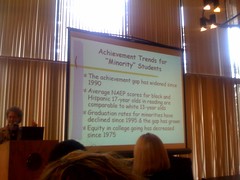
Kerner Forum on Education 1

Achievement Rates for “Minority Students�

  • The achievement gap has widened since 1990
  • Graduation rates for minorities have declined since 1995 and the gap has grown
  • Equity in college going has decreased since 1975

Progress since Brown v. Board of Education in 1954?
The desegregation movement is falling backwards. The peak of desegregation in schools happened in 1968 with about 47% of American schools being integrated. In the 2004, we are back down to pre-Brown v. Board of Education statistics with about 27% integration. What happened?

It’s so easy for us to think that race is not an issue any more, but when you look at schools these days, the wealthiest schools are where the high income White folks tend to flock to, while our low income urban schools continue to educate a majority of our Black and Latino kids.

I’m proud to say that I work with one of the most diverse schools in our nation, Menlo-Atherton High School (MAHS), but that is proving to be more of an outlier than the norm. And even within schools like MAHS, we can easily see what many of the Kerner Forum presenters called “Apartheid education,� where Whites and Asian-Americans are privy to special high-achieving tracks of education, like Advanced Placement classes, and Blacks and Latinos are relegated to remedial/intervention classes, even if they do not need to take them. Oh and I’ve seen this firsthand. I cannot tell you how many times it breaks my heart to see one of my students come in with her transcript showing me that she’s been “tracked� into business math or a second year of the same subject even if she doesn’t need it, only to find out later that it was a waste of time and won’t help her when she’s applying for college. And don’t even get me started on the students who are tracked into remedial English classes just because they speak a second language at home.

And yes, it hurts. I was one of those kids. I remember when they wouldn’t let me be part of the “Gifted, and Talented Education� (GATE) program at school because I had just moved to the country and couldn’t speak English as proficiently as a native speaker. Luckily, I was savvy enough to figure out the system, and I had the support from my parents and some special teachers to make sure that I was on the right path to college. But it’s so easy for a gifted and talented young person to fall through the cracks in today’s reality of Apartheid education. It’s segregation masked in progress.

It hurts, but it’s so validating for the work that we are doing.

Solution Space
If America’s number one route for “job training� is in our education system why do we put the least amount of resources into it? Our school system and infrastructure is based on antiquated industrial complex solutions. And the way we measure the success of our schools is boiled down to a numbers game: how many students graduate from high school?

Imagine if we held our schools to a higher expectation? What if we measured their success by how many students graduated from their school and went off to college? It seems like a minor shift, but it’s a reality that we cannot wait for others to create.
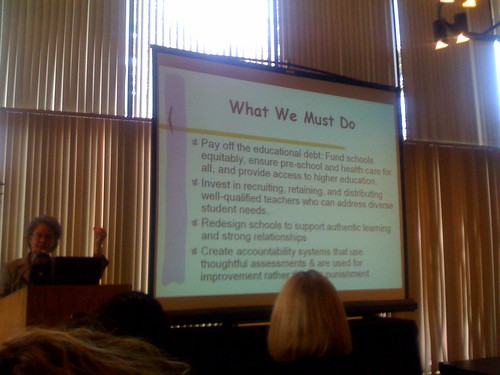
Kerner Forum 3

What we must do together as a nation

  • Pay off the educational debt: Fund schools equitably, ensure pre-school and health care for all, and provide access to higher education.
  • Invest in recruiting, retaining and distributing well-qualified teachers who can address diverse student needs.
  • Redesign schools to support authentic learning and strong relationships.
  • Create accountability system that use thoughtful assessments and are used for improvement rather than for punishment.

And according to Linda Darling-Hammond (pictured), co-director of Stanford’s Center for Opportunity Policy in Education, all of this could be done “for the cost of one week in Iraq.� While it can be easy to throw your hands up in typical 20th century-style apathy, as a nation, we cannot afford to ignore our educational crisis.

Can we act now to avoid an educational crisis akin to the $700 billion crisis in our financial sector?

Can we as adults advocate for our young generation who cannot vote?

Can our voices can get loud enough to be heard by superintendents, politicians, and policymakers?

Absolutely.

And in the meantime, let’s keep doing the good work we are doing because before you know it, the students who we were once supporting and encouraging through their algebra homework or presentation–be it Rosa, Freddy, Brianna or Vince–might be the ones standing by us as we fight for educational equity.

Continue reading The State of the American Education System is a Disaster…
Trendspotting: Philanthropic Weddings

I’m going to four weddings in the next nine weeks. As Karla told me, we are coming to that age when many of our friends from high school and college are getting hitched.

I’m really looking forward to Mike and Alex’s wedding this upcoming Sunday because 1) Alex is one of my best friends and we go all the way back to the elementary school days, and 2) they’re employing what I think is a pretty neat philanthropic idea at their wedding.

You know how at the end of weddings, they give out those (usually) tacky wedding favors? Generally it’s a piece of plastic crap that has the couple’s names and the date of the wedding on it. Or perhaps it’s a food-related favor like a bag of cookies or packaged cupcakes. Alex’s idea was rather than paying $3-4 per person for a random wedding favor, she would instead donate the cost of the favors per person to a nonprofit organization that she and Mike valued. She  asked me to help her choose a nonprofit organization or charity that aligned with their values, and after some research, I sent her a list of 17 recommendations, and my opinions of each. The list included some of my favorite orgs like College Summit, Ashoka, and Green for All.

She recently told me that she and Mike chose BUILD (I swear I didn’t twist her arm or anything) as the recipient for the donation, and each guest at the wedding will receive, in lieu of a wedding favor, a little piece of paper describing the organization.

In two weeks, I’m attending Erwin and Coy’s wedding–Erwin is my chorus brother and their wedding will be my first gay one (Go California!)–and they are also employing philanthropy at their wedding. On the back of their invitation, they’ve written:

Because we already have more things than we need, in lieu of gifts we ask for donations to help continue the right of GLBT folks to marry. We encourage gifts to Equality California at www.eqca.org/wedding.

It’s hard not to be cynical at weddings, but given that both of these weddings have the underlying theme of giving back, I think they might turn out to be fun after all.