Last month I had the incredible opportunity to partake in the Dubin Fellows New York City Leadership Trip, and I have just recently started to process the entire amazing experience. I joined about 20 Harvard Kennedy School classmates in New York City to have intimate conversations with high-impact, socially minded leaders–like Mayor Michael Bloomberg, Former NYC School Chancellor Joel Klein, Harlem Childrens Zone CEO Geoffrey Canada, and Teach for America Founder Wendy Kopp. The three-day sojourn was sponsored by Glenn Dubin, who is the founder and leader of Highbridge Capital, a successful hedge fund company.
Conversing with Joel Klein
The most impactful portions of the three-day trip were the meetings with both Joel Klein and Michael Bloomberg. Because of my background working in the education sector and my aspirations to be part of the movement that creates systemic change in the sector, the entire weekend seemed to be specially tailored to my interests since we met with several prominent education leaders! Our discussions with Bloomberg and Klein really helped to give me the bigger picture perspective on leadership and how to make an impact through different angles in my life. I could tangibly feel Bloomberg and Klein’s energy and sense of purpose. I felt like both of those meetings were also a call-to-action in some sense, and it seemed like they were giving us as much advice and wisdom as they could because they could see that we were the next generation of leaders. In that sense, I was invigorated and felt empowered by their call-to-action.
EDUCATION IS A “PEOPLE BUSINESS”
Bonding with Geoffrey Canada
I think it was coincidentally appropriate for the field visit to be so educationally skewed because of the urgency of the issues facing the education sector. My biggest take away from those conversations was that education is a “people business.” Despite all of the issues surrounding the debate for solutions, the education sector needs an infusion of great talent at all levels in order to create true systemic change. Multiple leaders–Deborah Kenny (CEO of Harlem Village Academies), Canada, Kopp, and Klein–mentioned this pressing need, and again, personally it felt like a call-to-action. To me it also signaled an incredible opportunity, and got me thinking, “how can we open up and widen the pipeline of talent into the education system and what are the levers we can use to make that happen?”
SCALING IMPACT
Asking Wendy Kopp an important question
Another major issue that was constantly in the back of my mind was the issue of scaling impact. How were these leaders tackling the issue of scale, or were they at all? It was fascinating to see the different approaches to scaling impact from the very strategic and methodical widespread impact (Teach for America, Endeavor) to the thoughtful saturation of one market (Mt. Sinai Adolescent Center, Harlem Children’s Zone, Harlem Village Academies). Throughout the trip, I wanted one of the leaders to just tell me which method was the right way to go, but it became clear that there is no one right answer. Both approaches seem to be necessary in order to push an entire movement forward. However, I did appreciate getting insights from Kopp, Rottenberg, Canada and Weinstein (Robin Hood Foundation) about using data to thoughtfully inform their decision-making. And what I realized about myself is that I am the type of leader who doesn’t just want to create an excellent program that serves one market well; rather I realized that I am the type of leader who strives to disrupt a system to create long-lasting change at a large scale. Listening to Kopp talk about starting Teach for America with 500 corps members because that was the tipping point for a national movement really resonated with me.
The group with Wendy Kopp
Probably the biggest takeaway I had was not even a tangible meeting or something that a leader said, but for me it was having the incredible opportunity and privilege to join a talented group of students to meet some highly accomplished leaders. Being surrounded in that environment with these people is something that was truly energizing, and something that I had never dreamed of. I kept thinking about what the young me (shy, immigrant kid) would have done in that environment, and it blows my mind to realize that I had this opportunity. It was affirmation for me to follow my heart and my instincts and to continue to fight for what I am passionate about. All of the leaders we met were inspirational in that they were following their hearts and doing what they believed was right. I appreciated being in their presence, and truly appreciated having the opportunity to be part of this prestigious group.
FUTURE LEADERS
Fellows at the Colbert Report
At one point during the field visit, I looked around the conference room and I didn’t see the faces of fellow graduate students or competitors vying to get better grades in class or the more profound answers to questions. I saw the faces of future leaders, movers, shakers, and change-makers. Future colleagues, funders, mentors, advisers, friends, confidants, and comrades fighting against inequity and injustice. I was rejuvenated when I realized that we will be making an impact on the world soon, and we all had this foundational experience together. Learning about their rich experiences during busrides, lunch, or en route to the next meeting was valuable, and I sincerely hope that we take the opportunity to stay connected with each other.
BREAKING SOCIAL BARRIERS
Growing up, I rarely engaged with people outside of my social strata. I think there was a sense that barriers existed between people from different social classes, particularly if you grow up with humble means. What I appreciated about my interaction with the Dubins is that they made sure that those social barriers did not exist with them and even among the visiting fellows. They went out of their way to expose all of us who came from different backgrounds to high-performing leadership. Glenn was incredibly down-to-earth, and from his example I was reminded that high-performing leaders are people, too. I was able to see myself in his shoes. The biggest lesson that I learned from Glenn Dubin was the importance of finding, cultivating and nurturing talent. And to do that, you’ve got to be able to communicate, connect and build relationships with people not in spite of your differing backgrounds but because of them.
I cannot emphasize enough how grateful I am to the Dubins, the Harvard Center for Public Leadership staff, the Highbridge staff, and all of the leaders we met, to have had this incredible opportunity! It was a clear call-to-action, and I will definitely use what I have learned to make an impact on our society.
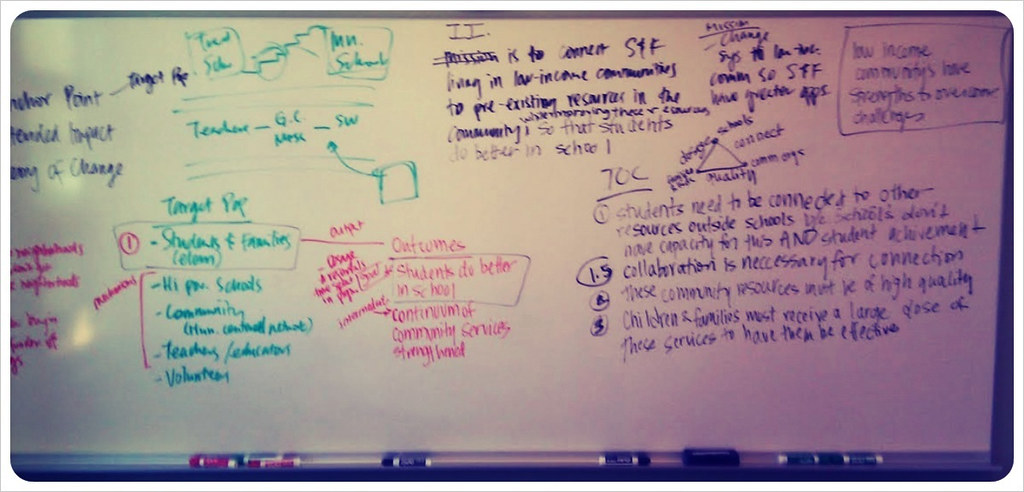
My fall semester at Harvard has been a great mental playground. I learned a ton about the enormity of the problems with our national education system while also starting to dream up some potential solutions. I recently wrote a business plan for a national social venture that aims to solve some of our nation’s issues, and below is a portion of an essay that I wrote that catalyzed that plan. The prompt was “Why has it proven so difficult to create more good schools in the US, particularly in urban areas?”
Stronger Schools from Stronger Communities
The exploding growth of the American economy in the past century created a platform for incredible educational opportunities for middle and high-income communities, while simultaneously limiting educational opportunities for those in low-income communities. In his book Savage Inequalities, Jonathan Kozol (1991) gives us a disturbing view of how high poverty East St. Louis was plagued by struggling schools that are choked by a lack of resources. The problems of creating and scaling effective schools in urban America are due to the pervasive social inequities inherent in low-income communities like East St. Louis. In order to tackle this root cause, solutions need to address the social context in high poverty communities. A promising solution lies in building a strong network of support within and around schools in low-income communities to provide a network of comprehensive wrap-around services for students and families, while promoting the school as a community hub.
Critics would argue, however, that creating such a network of services to fight poverty is not only beyond the scope of schools, but also beyond schools’ means. I contend that building this network of support within and around schools in high-poverty urban areas is a small price to pay for positive results. Another solution is to give families school choice so that students can theoretically attend schools that provide a higher level of academic and social support for students and families. Yet because we want sustainable solutions, we must build scalable solutions that start at the local community level. By building a strong network of support within and around schools, students will do better academically and families will have more access to the services they need to lift themselves—and their communities—out of the shadow of poverty.
Poverty Bleeds into Schools
In urban communities, students bring the most pervasive social issue—poverty—into school everyday. As stated in the Coleman Report (1966), “A school’s poverty level is a stronger predictor of how a child will fare in school than any other factor save the child’s own socioeconomic (SES) background.� Attending a high poverty school likely means that the student comes from a high poverty family and community. As Traub described, “educational inequality is rooted in economic problems and social pathologies too deep to be overcome by school alone� (2000). The current educational system cannot handle and sustain the heavy case management required to help students and their families deal with the plight of poverty. When students face problems, like health and dental issues, poor nutrition, violence, gangs, and drugs, school becomes a low priority (Kozol 1991). Because the problems are so commonplace and the interventions are “so slow and heavily encumbered with red tape�, teachers and administrators’ perceptions of normalcy have become skewed; they learn to operate and live with the glaring social issues (Kozol 1991, 21).
We can see then that high poverty urban schools are unable to swiftly address student needs outside of the classroom because they lack capacity and, furthermore, it has not been the schools’ responsibility or goal to lift students and their families out of poverty. Our society has drifted away from the common school movement of the 1800’s when “spreading prosperity and ending poverty� was an important aspect of creating public schools (Wirt and Kirst 2005, 32). In this day and age there is no unified expectation for schools to address student needs that stem from poverty, and thus schools have no incentive to do so. However, if students’ basic needs—like housing, health care, nutrition, and safety—are not adequately met, we also cannot expect schools alone to compensate for the consequences of poverty (Warren 2005).
A Network of Community Partnerships
It is interesting to note, however, that in any given urban community, a myriad of external service providers already exists to support low-income students and families. The issue seems to not stem from the dearth of social services, but rather from a lack of direct links between schools and the necessary service providers. In my own work experience at BUILD, a college access nonprofit organization, we provided direct services to students in low-income communities like East Palo Alto and Oakland, California. I observed that while there were a plethora of service providers in the East Palo Alto and Oakland, they almost never collaborated or shared resources with schools and with each other. Furthermore, many of the service providers had only marginal relationships with the surrounding schools. While the service providers perceived that they were doing good work in the community, there was only a tangential relationship with surrounding schools during the fall recruitment season.
By consciously partnering with community development organizations, schools can work together with the community to directly raise the level of social and economic health of families. By addressing problems that students face in a holistic manner (e.g. if students had adequate healthcare, received proper nutrition, and were safe from violence and drugs), students would be healthier and safer and schools would thrive. However, there is a link missing between service providers because oftentimes schools do not build relationships with them.
By strengthening the schools’ relationships with external service providers and also connecting service providers with one another, we strengthen the network that can support not only students, but also families. It is not enough for external service providers to fill a void that schools are unable to because teachers and counselors often do not have the capacity to research service providers, pick out ones based on a student’s need, and refer them to the appropriate one. However, if a school is the hub of a community, we can create a centralized and organized system that connects teachers, students, families and service providers in an efficient manner with one another. This centralized system could serve as an efficacious information-sharing process that students and their families can use to access services—like homeless shelters, job training programs, and food banks—that will likely improve their livelihoods.
It’s Sunday night (Jan 2) here in the Philippines, and I’ve been having a fantastic time catching up with my family before getting started on the Gawad Kalinga project. I’m staying with Tita Badette, Tito Bong, Jovic, Gelo and Bea, and we celebrated New Years with my Tito Eddie, Tita Ving and Robert. I thought the end of the world was coming, but it was just the hundreds of illegal firecrackers going off all over the city. And of course, we ate tons of amazing food. Yum.
I got some more concrete details about the project plan, and below is my schedule for this week.
Monday, Jan 3
Meet with GK National Office folks to get more background on the organization. We are possibly meeting at a farm in Valenzuela.
Tuesday, Jan 4
Meeting with the team that runs the Center for Social Innovation (CSI, catchy, huh?), including GK Founder Tony Meloto, at Ateneo de Manila University (one of the top universities in the Philippines). They’re going to give me an orientation on CSI, and then in the evening, I’ll get to meet some of the entrepreneurs from the program.
Wednesday & Thursday, Jan 5-6
We are heading to check out some GK farms/villages in north Bulacan, which is a provincial area just north of Manila.
Over the weekend
I’m spending the weekend in Bacolod, which is about an hour and a half flight away in Western Visayas. This is the target location for the next expansion of CSI, so it’s important that we check this out. They speak Visayan there, so that should be interesting since I don’t speak Visayan and I’ve never been there. Come to think of it, I don’t think I’ve been to northern Bulacan either.
Map of Bacolod
In between the work, I’m also trying to get together with a few other relatives and family friends. So far the trip has been great (thanks to my family here), and the rest of it should be quite an adventure.
At the beginning of 2010, I said that this was going to be the year of taking incredible leaps and trusting that I’ll land safely, even though I wouldn’t know exactly where I would wind up. Ominously, last year at this time I said that 2010 was not going to be easy, and guess what…. it wasn’t. 2010 was indeed a rollercoaster of a year. After spending a inordinate amount of my fall of 2009 working on grad school applications and essentially hidden from the world, I spent the beginning of 2010 wondering if all of that work paid off. And then in January, there was a large blow to our family when my dad’s mother, Nanay Ising, passed away. I was able to be there with her in the Philippines during her final moments, but it was an incredibly sad way to start 2010. I knew, however, that my grandmother was with me in spirit on March 22 when I received my acceptance letters to Harvard. The beginning of the year was truly bittersweet. Here are some other highlights from the year.
Spending Nanay’s funeral and mourning period with my entire family in the Philippines
Trips to New York (Tony’s bday & watching the US Open), DC, LA (Steve & Jen’s wedding!), Austin, New Hampshire, Maine and of course Las Vegas (oh, and my parents moved to the Strip!)
Finding out that my little sister got engaged, and then finding out that she’s pregnant!
Going on my 10th BUILD college tour
Leaving BUILD (and SF) in July after 5 amazing years
Moving to Cambridge and starting at Harvard
Getting certified as a Rap Director after 3 years of training with College Summit!
Dream come true: visiting the mother of all mother countries (Spain) with Karla and falling in love with Sitges, a gorgeous beach town
Meeting CEO’s of successful nonprofits: Year Up, Pratham, Planned Parenthood, United Way, and more
Watching some awesome speakers: Muhammad Yunus, Michelle Rhee, Rachel Maddow, Arne Duncan (OK, so he wasn’t an awesome speaker, but it was interesting nonetheless)
Becoming an uncle when my brother’s baby, Elliot, was born in October
Writing a business plan for my Education Policy course that I will probably launch
Let’s not forget that Prop 8 was overturned and DADT was repealed
Raising enough money to work with Gawad Kalinga during my winter break
And as I do every year, I wanted to check-in on the goals that I set for myself last December.
Go on a spiritual journey – Yes, the trip to the Philippines for my grandmother’s funeral was quite the spiritual journey.
Take a GIGANTIC risk – There have been a couple of gigantic risks taken this year, but the biggest by far was leaving my position at BUILD after five years and starting my grad program at Harvard.
Get more involved and make a positive impact in the gay community by doing some gay rights advocacy work – This wasn’t exactly as I imagined, but I joined the staff of Harvard Kennedy School’s first-ever LGBTQ Policy Journal.
Learn how to write music and then write a song – Yes!
Build something with my hands – Yes, I built a laptop stand.
Continue improving my Tagalog comprehension and speaking skills – Yes, they’re getting better
Deepen my spiritual practice (yoga, Catholicism) – Yes, at least definitely with the yoga.
Read at least 8 new books – Yes, I think this is true, particularly since I started grad school, and we do a ton of reading all the time.
Connect with my international relatives at least once a month – Yes, via video chat or IM.
Continue spending time with family members – Yes, I took a lot of trips home.
It’s been a great year, and I’m really looking forward to 2011!!!
In less than 28 days, we reached 100% of the $2,500 fundraising goal with donations and pledges! Thank you so much to everyone who supported my project with a donation, with love and with positive energy. I sincerely could not have done this without you, and we are just getting started. Tonight, I’m flying out to Manila, and will spend the next three weeks working with Gawad Kalinga. I’m really excited to head back there to work on this fascinating project, and it’s really great to know I’ve got a ton of support from you.
I’ve been reading a lot about “crowdfunding” (kind of like crowdsourcing, but projects are financed rather than just talked about by the crowd), and this truly was an interesting experiment in crowdfunding (read more about it here). Here are some fascinating data from the fundraising (minimal amount of quant skills used!):
Total amount fundraised: $2,500
Total # of contributors: 70!
Minimum contribution: $5
Maximum contribution: $150
Average contribution: $35.21
Standard deviation: 30.16
# of clicks on the paypal link: 127 => More than 50% clickthrough rate
All quant stuff aside, this goal has been a fun foray into the world of fundraising! Well, I’ve got to pack my bags now for the three-week trip. I’ll update as much as I can in the Philippines!
I can’t believe I’m nearing the end my first semester here at the Harvard Kennedy School. Over the last few months I’ve been knee-deep in the ethics of public service, the quantitative joys of microeconomics and statistical analysis, and riveting cases in the nonprofit and educational sectors. While I am loving my academic experience, I have been yearning to get my hands dirty — to apply these learnings to something real and tangible. Just when I was starting to get this itch, an amazing opportunity popped up!
GK Community Members
Back in early November, I had the privilege of meeting Tony Meloto, the founder of Gawad Kalinga (GK, which means to “give care”), one of the Philippines’s largest and most successful NGOs addressing poverty in my home country. At a presentation at Harvard, he spoke passionately about GK’s mission to eradicate poverty for over 5 million Filipinos over the next decade by building communities and empowering impoverished people. I was inspired and hooked.
I had never met a Filipino who was so passionate about a social cause until that day, and I knew I wanted to learn more from him and GK. After chatting with him at school and through a few international video conferences, I volunteered to do a consulting project with GK. Based on their needs and my background, I will create a strategy to scale GK’s newest initiative, the Center for Social Enterprise. Basically I will help GK figure out how to create more business incubators in low income communities, so more people are empowered to be entrepreneurs in their communities across the Philippines.
Community building
I just could not pass up the opportunity to make a difference with skills I’ve learned both professionally at BUILD and academically at Harvard. So instead of hanging out on the couch during my winter break, I’ll be spending about 20 days in the Philippines in January to do field research in Manila. I’ll be meeting with GK staff and community members, learning the ins and outs of their process, and formulating a replication strategy that is founded not only on the theoretical stuff I’m learning here, but, more importantly, the practical day-to-day operations. On a personal note, this will enable me to give back to the country in which I was born and will hopefully be the start of my foray into international development work. Because this project goes beyond the expectations of schoolwork here at Harvard, there is no funding available for first year students to do international development projects.
This is where you, my kind and generous friends, come in. I leave in about one month, on Dec 29 for Manila, and I need to raise $2,500 to allay the expenses of the trip, like my flight, food, public transportation, etc. If you and 99 other friends donate just $25, I’ll be set and more Filipinos in low income communities will have the opportunity to start socially responsible businesses that improve their communities. Any amount I make over $2,500 will go straight to GK as a donation.
I hope that you will be able to support me and GK’s mission by making a donation today and by spreading the word to other friends who may be able to help. Thank you!
I’m currently reading a book called Better, by Atul Gawande, that shares insightful stories about medical practice from a surgeon’s perspective. The stories highlight how medical professionals are only human and therefore must always be diligent and resourceful in fulfilling their duties — and the stories have lessons that spill outside of the hospital and even into the education system. What stuck out to me was a story about how hospital microbiologists tried and failed at getting medical staff to wash their hands more frequently — as you may know med staff were/are the primary carriers of infectious bacteria in hospitals so minimizing the amount of bacteria on their hands dramatically decreases the rate of infection in hospitals.
A hospital in Pittsburgh brought in Industrial Engineer Peter Perreiah to solve the problem of hospital infections in one wing of the hospital — and he created systems and structures that “made each hospital room work more like an operating roomâ€� (where they are very diligent about being disinfected). For a while his “Search-and-destroyâ€� strategy worked: “Infection rates for MRSA fell almost 90 percent.â€� However, after two years these great ideas only spread to ONE other wing at the hospital… Why? Perreiah came in and told people how they had to change rather than “building on the capabilities people already had.â€�
After reading an article about how Save the Children changed their approach to improving child nutrition in poverty stricken villages in Vietnam, he came across the idea of Positive Deviance, which “is an approach to behavioral and social change based on the observation that in a community, there are people (Positive Deviants) whose uncommon but successful behaviors or strategies enable them to find better solutions to a problem than their peers, despite having no special resources or knowledge.” Through the positive deviance approach, an important assumption is that communities already have the solutions to the problem. They are the best experts to solve their own problems.
So this time they tried the positive deviance approach with a series of 30-minute, small group discussions with all the health care workers in hospital. They had no agenda: “We’re here because of the infection problem and we want to know what YOU know about how to solve it.� And from this came great discussion and furthermore ownership of the solutions. And the results were staggering: rate of MRSA infection dropped to zero the next year and stayed that way.
What does this have to do with education or for any kind of initiative, you ask? If you think about it, organizations–whether governmental, nonprofit or business–approach problems like that industrial engineer approached the problem initially. He used his expertise to to minimize waste and increase efficiency, and above all he mandated the solutions to the hospital. Many organizations purport to have the best solution, most efficient way to handle a situation, or the most optimal way to eradicate a problem. But how many of those solutions actually stick around once the organization leaves? And isn’t the point of a nonprofit organization to work its way to nonexistence — because by reaching the nonprofit’s mission, you thereby render that nonprofit irrelevant.
Yet there are many examples of organizations that operate in communities without drawing solutions, ideas, and representation directly from the very people in the communities. Please note that I’m not criticizing how well these organizations operate. In fact, some operate extremely well. But if that organization, or that group of people, left the community, would their lasting legacy be a self-sustaining system that empowers the people of the community or would their lasting legacy be forgotten in a dusty pile from those who tried and failed to create something that the community embraced?
This makes me think of the renewed energy in the New Orleans’ education sector where most of the schools are now run by national charter management organizations and staffed by bright-eyed outsiders. When the appeal of “saving” New Orleans runs out, will these people stay? And more importantly, when shaping the new education landscape, did they elicit solutions from and empower the citizens of New Orleans to create a sustainable new education system?
I hope so. Sustainability and a community-based approach should be tantamount to any organization that wishes to improve the livelihood and well-being of those living in poverty.
I recently read a book by Frederick Hess, entitled Commonsense School Reform, and so far my favorite quote from it is “…great schools are not legislated into existence… they require nuanced leadership that forges a sense of shared purpose, rewards creative thinking, and inspires excellence. Public policy cannot mandate great schools any more than it can mandate great leadership of great teaching; it can only make it easier or harder for great schools to exist.â€� But the reason that we have bureaucracies plaguing our educational institutions — that trickles down to our principals and our teachers — is because so many good recommendations get pushed through legislation without a clear, thoughtful strategy. So while states mandate classroom sizes, teacher requirements, curricula standards, assessment test conditions, etc., all of these just add to the confusing patchwork quilt of “reforms” that are supposed to improve student outcomes. In reality, however, these perpetuate a culture of compliance! As Hess put so eloquently, “Compliance rewards obedience rather than excellence.”
Finland vs. USA
I attended a discussion last week with Harvard Professor Tony Wagner, who presented his findings from his 10-day delve into Finland’s education system–Finland arguably has the best and highest performing education system in the world according to a set of international assessments that the OECD nations partake in (read more about it here and here)–and I was immediately struck by the subtle yet pervasive differences in their culture of education. Wagner kept bringing up that their education system’s foundation was built on a system of trust. State trusts that the districts will manage. Districts trust principals to lead their schools to the highest results. Principals trust teachers to teach effectively and to deliver results. Teachers trust students to be engaged in the classroom and to take responsibility for their education. The culture of trust not only trickles from top to bottom, but also throughout the Finnish society.
Americans, on the other hand, love to do assessments, and when those assessments aren’t stellar (as evidenced by any number of recent studies), we love to play the blame game: it was the teachers’ faults, the principals’, the districts’, the unions; it was because we did not have enough money/resources/support or not enough family involvement. If we are starting our education reform conversation by placing blame, we easily marginalize essential groups of people: teachers, principals, unions, families, schools of education. How can we expect everyone to be bought in to the recommendations and reforms in an environment that is so unsafe? We need to move away from our system of distrust and compliance, and start to cultivate a culture of trust. The question is… is that too un-American?
I love my classes so far, and I particularly am enjoying Education Policy, which is a course I’m taking at the Harvard Graduate School of Education (which we lovingly refer to as “HGSE,” pronounced HUGS-SEE). I feel like as I have been working in the youth development field, I have been working under many assumptions about our education system and how it is failing our students. Because of this class, I am actually getting a better understanding of the history of education in our country and I can pinpoint to some of the biggest and most pervasive issues that have caused and are still causing educational inequity.
And I wonder how our society will react to the upcoming alarmist (or what I assume will be alarmist) education documentary, “Waiting for ‘Superman‘“, which has gotten a lot of buzz recently. If you haven’t heard about it, you can view/read more here, here, and here. In short, this documentary has the potential to do for education reform what “An Inconvenient Truth” did for the Global Warming debate — stir up conversations and catalyze action. On a surface level this will be very positive for the education reform movement, and I predict that it will galvanize our communities and nation toward the movement. However, I am worried that because there are so many policy issues and that the true societal issues run deeper than just education, we may be missing the point. “The gap between beliefs and actions not only leads to contention and confusion, it also generates policies that are irrational in the sense that they are inconsistent with evidence of what works or are not based on any evidence at all.” (Hochschild and Scovronick)
Will this latest reaction from the documentary just be the next short-term fad? How can we capture this impending moment and truly galvanize people toward fighting for long-term results? We keep talking about how institutions (healthcare, school districts, housing, employment, etc.) need to come in, support the issues, and fix the problem. I am starting to get more clarity around where and how reform can most effectively be made, and that seems to be at the local level. My hunch is that until we can reinvigorate the culture of under-resourced communities, we’ll just be pouring money into a black hole. In addition to partnering with these important institutions, we need to take a multi-pronged approach to empower the people that actually live in the communities: with consistent and high quality education for the youth, economic opportunities for employment/capital/venture funding for the adults, and healthcare and housing opportunities for all.
The first week at Harvard has been a rollercoaster. Coming off of a fantastic vacation in Spain, I definitely started out on a high note. Even biking around town in the pouring rain to buy groceries and take care of other business didn’t really phase me. Sure, I miss my car a lot. Every time it rained in San Francisco — actually even when the sun was out — I took my trusty Prius to where I needed to go. This biking/walking/busing lifestyle will take some adjustment, but I’m getting there.
And then orientation at the Harvard Kennedy School of Government started, and let me just say that I have some ridiculously amazing classmates. We’ve got a guy who was one of the first astronauts from South Korea, a lady who has her MD and her MBA and who’s looking to get a third. We’ve got fellow nonprofiteers, former teachers, servicemen and women, and people who have hobnobbed with heads of state. We have this one girl who has three passports, and this one guy who has visited 86 countries. We’ve got future politicians, future ambassadors, future foreign ministers, leaders who are bound to make some real social change in the next few years. Wow. To say that I was humbled on that first day upon meeting my classmates is an understatement, yet I held my own. I know my purpose here, and I am extremely excited to have such high caliber classmates to add to the fabric of my education.
However, I’m not going to lie. There was a millisecond where I felt like I slipped in undetected, like I was a spy living a double life. “I snuck into Harvard! I got in without them noticing! Ha!” I certainly felt a tinge of that as I sat in HKS’s storied John F. Kennedy Jr. Forum, where heads of state, celebrities and students all have had the chance to speak. But Debbie Isaacson, the director of the MPP program, reminded us that “Harvard does not make admissions mistakes. You belong here, and you were meant to be here.” And as several other speakers reminded us on day one, each of us was chosen because of our propensity to be leaders and our drive to fix our world’s most pressing problems. We answered the call.
So as I lay here in bed, after a long weekend of being ill (I had to get these vaccinations, which caused side effects, like fever, aches, cramps and tiredness, for about 48 hours), I am still astonished at this journey of which I am about to embark. And I remain grateful to everyone that has helped get me to this place.
Wish me luck as I start classes this week! (And that I get over this illness quick so I can actually go to classes!)